
Introduction
Not all surfaces are created equal. In the world of stone fabrication, assuming a material works everywhere is a costly mistake. For homebuilders and renovators, understanding where quartz can or should not be used is the difference between a lifetime installation and a surface failure within six months.
Quartz is an engineered product, typically composed of roughly 90–93% crushed natural quartz mineral and 7–10% polymer resins and pigments. While this composition makes it incredibly dense and non-porous, those same resins dictate strict environmental boundaries. Different environments—ranging from sun-drenched outdoor kitchens to high-heat commercial bakeries—place vastly different demands on a slab. If you ignore the chemical reality of the material, it will fail.
Quartz Installation Suitability Scale
| Application | Suitability Rating | Primary Constraint |
| Outdoor Environments | Very Low | UV exposure causes permanent yellowing. The sun “cooks” the resin binders. |
| High-Heat Areas | Very Low | Resins can scorch or melt above 150°. High risk of damage near grills or pizza ovens. |
| Indoor Kitchens | High | Best for prep due to non-porous surface ; however, direct high heat must be avoided. |
| Bathrooms & Wet Areas | High | Impervious to moisture and bacteria. Ideal for high-humidity vanity environments. |
| Vertical Accents | High | Excellent for grout-free backsplashes. Requires mechanical fastening for large slabs. |
| Commercial Applications | High | Exceptional for front-of-house use. Easy maintenance and high durability against abrasion. |
| Flooring Applications | Very Low | Significant slip hazards. Risk of structural deflection and unrepairable wear patterns. |
Outdoor Suitability
UV Stability
Quartz is fundamentally unsuitable for outdoor use. The resins used to bind the crushed stone are not UV-stable. When exposed to direct or even indirect sunlight, these polymers undergo a chemical reaction called photodegradation. Essentially, the sun “cooks” the binder.
Color Fading Potential
The visual result of UV exposure is catastrophic. Light-colored quartz countertops will typically turn a sickly yellow or amber hue. Darker slabs often experience “whitening” or a chalky appearance as the resin breaks down at the surface. This is not a stain that can be cleaned; it is a permanent alteration of the material’s chemistry.
Freeze / Thaw Conditions
While quartz is non-porous and won’t absorb water that leads to internal cracking, it struggles with thermal expansion. The resin and the stone expand at different rates. In climates with extreme temperature swings, this internal tension can lead to warping or hairline fractures over several seasons.
Long-Term Outdoor Performance
Expect a quartz slab installed outdoors to lose its polish and structural integrity within 12 to 24 months. Even under a covered patio, UV bounce from surrounding surfaces is often enough to trigger discoloration. If an outdoor space is the goal, quartz should be removed from the list of options immediately.
Recommendation: In outdoor installations, materials such as granite and quartzite are significantly better suited due to their natural weather resistance.
Kitchen Suitability
Food Preparation Areas
The kitchen is where quartz earned its reputation. Because it is engineered to be non-porous, it is an ideal surface for primary food preparation. Raw meats, acidic juices, and oils cannot penetrate the surface.
Busy Household Kitchens
In a high-traffic residential kitchen, the primary benefit is the fact that it doesn’t require sealing. Unlike natural stone, which requires periodic intervention as noted in the Quartz Countertop Maintenance Guide, quartz remains functional with minimal effort. It is built for the “working kitchen” where spills are common and immediate maintenance isn’t always possible.
Island Installations
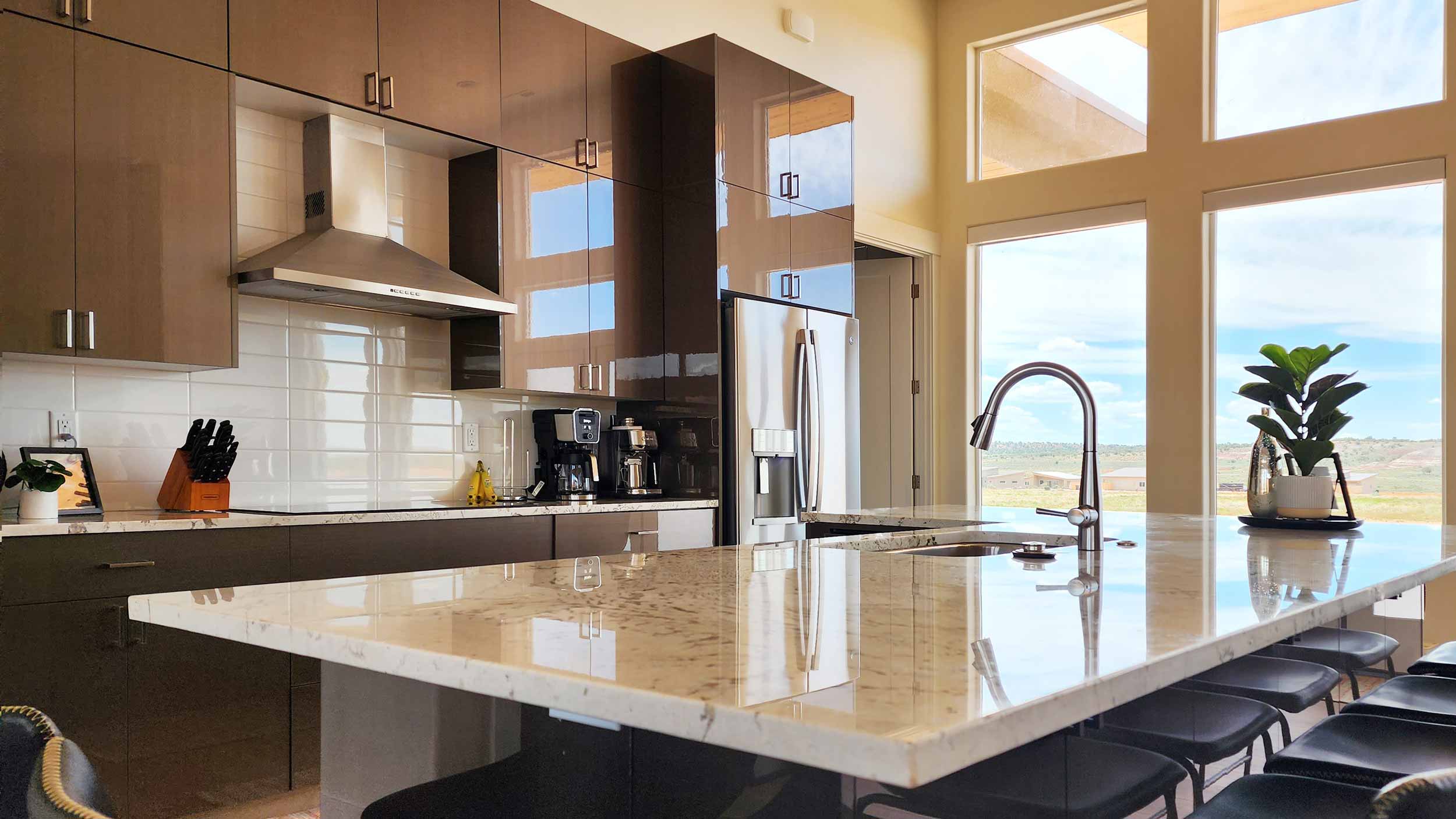
Quartz is an excellent choice for large central islands. Because it is a manufactured product, slabs are available in jumbo sizes that allow for massive, seamless spans. Furthermore, the tensile strength provided by the resin allows for slightly longer cantilevered overhangs for seating areas compared to more brittle natural stones, provided proper support brackets are used.
| Kitchen Type | Best Suited Materials | Key Advantage |
| Family / High Use | Quartz | Low maintenance and high impact resistance. |
| Gourmet / Chef’s | Quartzite, Granite | Superior heat tolerance for hot cookware. |
| Large Seamless Islands | Quartz | Availability of jumbo slabs. |
Recommendation: For indoor kitchen surfaces, quartz, granite, and quartzite are all excellent choices depending on specific durability and maintenance needs.
Bathroom and Wet-Area Suitability
Bathroom Vanity Installations
Quartz is arguably the perfect vanity material. Bathrooms are environments of high humidity and frequent chemical exposure (hairsprays, perfumes, toothpastes). Quartz is impervious to water damage and does not suffer from the “darkening” effect that occurs when water seeps into the pores of a natural stone slab.
Shower and Steam Room Environments
Using quartz for shower curbs, benches, and wall cladding is common and effective. However, steam rooms present a challenge. The constant, high-level heat of a steam generator can soften the resins over a long duration. While standard showers are perfectly safe, a dedicated steam environment may push the material beyond its intended thermal limits.
Hygiene and Sanitation
In wet areas, hygiene is the priority. Because quartz lacks the microscopic fissures and pores found in marble or granite,it does not provide a harbor for mold, mildew, or bacteria. For more on the physical properties of the stone, see our Quartz Countertop Durability Guide.
| Wet Area | Best Suited Material | Performance Note |
| Standard Vanity | Quartzite, Quartz | Quartz is practical. Quartzite is more aesthetic. |
| Steam Room | Quartzite, Granite | Resin-free stone handles sustained steam heat. |
| Shower Wall | Quartzite | Stunning natural veining with high durability. |
Recommendation: For bathrooms and wet areas, quartz and quartzite are top choices, though quartzite requires more specific care.
High-Heat Applications
Fireplace Surrounds
Quartz can used for fireplace mantels and hearths, but there is a hard limit. It should never be used in a “true” hearth where it will be in contact with embers or direct flame. As a vertical surround, it is generally safe provided the fireplace is properly vented and the surface temperature of the quartz does not exceed 150°F. That being said, there are better options.
Sauna Installations
Avoid quartz in saunas entirely. The combination of sustained high heat and moisture causes the resin to expand and potentially off-gas. In a confined, high-temperature space like a sauna, the structural integrity of the slab can be compromised, leading to bowing or cracking.
Outdoor Cooking Areas
Quartz and grills are a recipe for failure. Beyond the UV issues, the radiant heat from a professional-grade grill or a pizza oven can easily exceed the melting point of the resin binders. Placing a hot pan directly from a grill onto a quartz surface will result in a permanent scorch mark.
| Heat Source | Best Suited Materials | Risk Factor |
| Fireplace Hearth | Quartzite, Granite | Can safely contact high radiant heat. |
| Sauna Interior | Quartzite, Granite | No resins to off-gas or expand. |
| Outdoor Cooking Areas | Quartzite | Highest natural heat tolerance available. |
Recommendation: For high-heat areas, granite and quartzite offer superior thermal stability.
Commercial Applications
Restaurant Installations
In the “front of house”—dining tables, bar tops, and host stations—quartz is exceptional. It handles the high turnover and frequent wiping of a commercial environment without losing its finish. However, in the “back of house” or commercial cook-lines, it is rarely used because of the risk of thermal shock from commercial cookware.
Retail Environments
For retail service counters, the consistency of quartz is its greatest asset. For example: if a national brand needs 500 locations to have the exact same counter color and pattern, quartz is the only material that can deliver that level of uniformity. It handles the “clatter” of keys, coins, and bags without the chipping issues common in softer stones.
High-Traffic Installations
In hotel lobbies or airport service desks, quartz is a workhorse. It maintains its luster under heavy use and does not develop the “hollows” or wear paths that can occur in softer calcareous stones like marble over decades of hand traffic.
| Commercial Use | Best Suited Materials | Performance Note |
| Bar Tops | Quartz | Scratch and stain resistance, no resealing. |
| Commercial Kitchens | Granite, Quartzite | High heat and heavy impact resistance. |
| Restaurant Tables | Quartz | Scratch and stain resistance, no resealing. |
| Reception Areas | Granite, Quartzite | Maintains luster under foot/hand traffic. |
| Retail Countertops | Quartz, Granite, Quartzite | Risk of staining is lower in retail space. |
Recommendation: For commercial use, quartz is excellent for front-of-house, while granite is a lower-cost option for heavy-duty kitchen work. Quartz, granite, and quartzite all have a place in commercial settings.
Flooring Applications
Quartz is typically not recommended for flooring applications due to structural and safety limitations.
Slip Resistance
Polished quartz is extremely slick when wet, posing a significant liability in flooring applications. While some manufacturers offer honed or textured finishes, they often fail to meet the required Coefficient of Friction (COF) for safe foot traffic in high-moisture areas.
Wear Patterns
Unlike natural stone, quartz is difficult to refinish once it is installed as flooring. While it is resistant to initial scratching, the heavy abrasive force of foot traffic can eventually dull the resin binder, creating “traffic lanes” that cannot be easily polished out in place.
Recommendation: For high-traffic flooring, quartzite offers high durability and natural slip resistance.
Vertical Applications
Backsplashes
The use of quartz as a full-height backsplash is one of the best applications for the material. It creates a seamless, grout-free surface that is easy to wipe down. Because it is not a load-bearing or high-impact surface, many of the concerns regarding scratches are minimized here.
Accent Walls
Quartz is increasingly used for decorative vertical features in lobbies and primary suites. Its weight requires a sophisticated mechanical fastening system; you cannot rely on adhesive alone for large vertical slabs. When installed correctly, it provides a striking, monolithic look that is much easier to maintain than a tiled wall.
Moisture and Stain Exposure
Vertical quartz in kitchens and baths is highly resistant to the splashing of oils or soaps. Because gravity prevents liquids from pooling, the risk of even topical staining is virtually zero.
Recommendation: For vertical accents, quartz, granite, and quartzite can all provide stunning visual results with high performance.