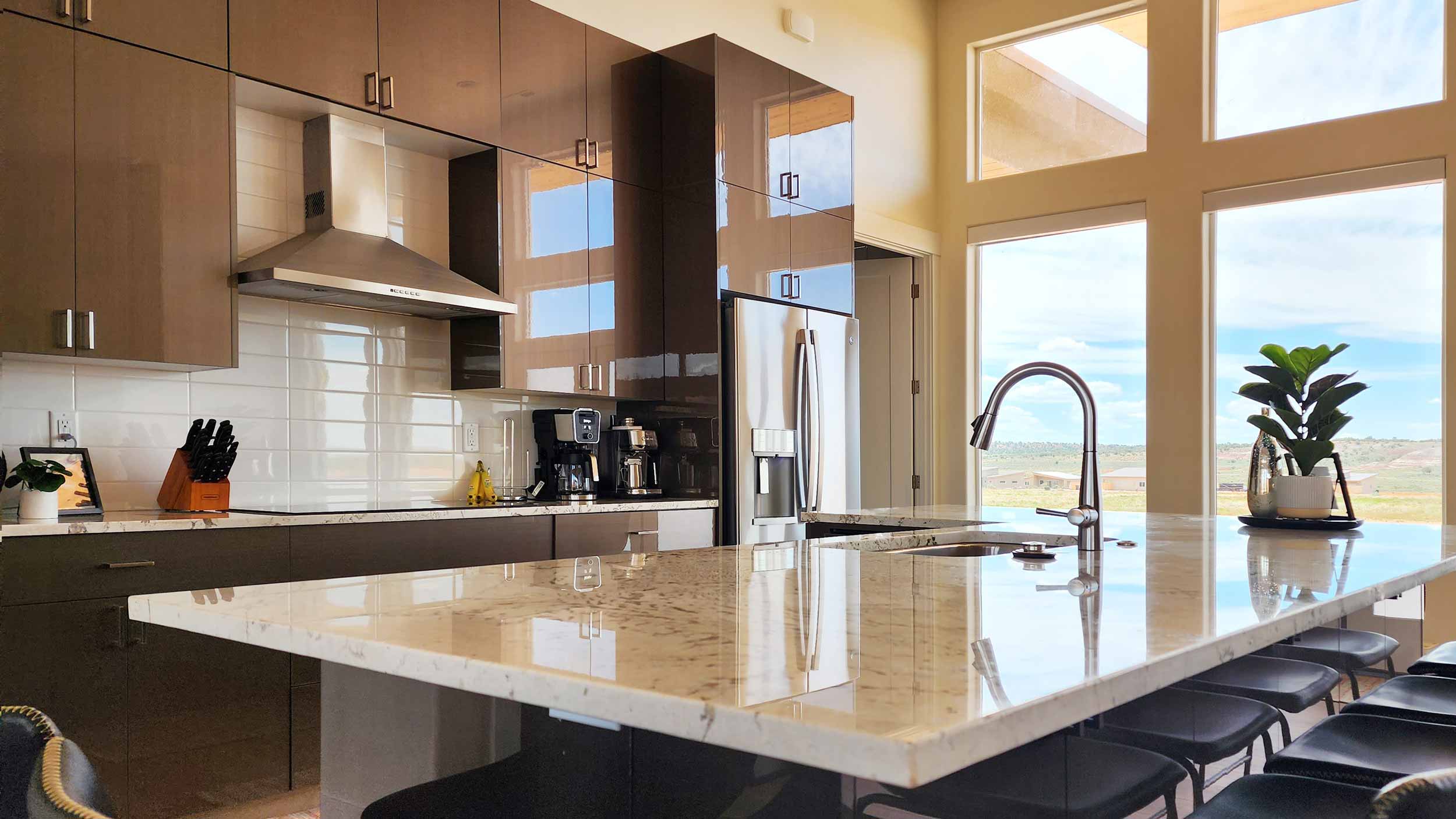

Durability is one of the most important factors when selecting a countertop material. Kitchen and bathroom surfaces experience constant stress from cooking heat, utensils, spills, cleaning products, and everyday use. Some materials tolerate these conditions with little visible change, while others develop scratches, stains, or surface wear over time.
Understanding how countertop materials perform under everyday conditions helps set realistic expectations before beginning a renovation or new construction project. No countertop surface is perfect in every situation. Each material has advantages and limitations depending on how the space will be used.
This guide compares several common countertop materials used in residential kitchens and bathrooms:
- quartz
- granite
- quartzite
- marble
- dolomite
Each material is evaluated using the same durability criteria so their performance can be compared under similar conditions.
Countertop Durability Comparison
| Material | Heat Resistance | Scratch Resistance | Stain Resistance | Ease of Maintenance |
|---|---|---|---|---|
| Quartz | 3/5 | 4/5 | 5/5 | 5/5 |
| Granite | 5/5 | 4/5 | 3/5 | 3/5 |
| Quartzite | 5/5 | 5/5 | 3/5 | 3/5 |
| Marble | 4/5 | 2/5 | 2/5 | 2/5 |
| Dolomite | 4/5 | 3/5 | 3/5 | 3/5 |
These ratings represent typical performance expectations for residential countertop installations. Individual slabs, fabrication methods, and installation quality can influence how a specific countertop performs over time.
Quick Durability Takeaways
Several patterns become clear when comparing these materials side by side.
Best heat resistance:
Granite and quartzite tolerate high temperatures very well because both materials formed under extreme geological heat and pressure.
Best scratch resistance:
Quartzite is generally considered the hardest of the materials commonly used for countertops, giving it excellent resistance to scratching during everyday use.
Best stain resistance:
Quartz provides the strongest stain resistance because it is an engineered, non-porous surface.
Lowest maintenance:
Quartz typically requires the least maintenance since the surface does not require sealing and resists liquid absorption.
More delicate natural stones:
Marble and dolomite provide distinctive natural stone character but are softer and require more careful use than harder materials.
Understanding Countertop Durability Factors
Several physical characteristics influence how countertops perform over time.
Heat Resistance
Heat resistance refers to how well a surface tolerates hot cookware and temperature fluctuations.
Natural stones such as granite and quartzite typically tolerate high cooking temperatures because they formed under intense geological heat and pressure. Brief contact with hot cookware rarely damages these stones.
Engineered materials like quartz contain polymer resins that bind crushed stone particles together. While quartz performs well under normal kitchen conditions, extreme heat can damage the resin component.
Marble and dolomite tolerate moderate heat but may experience thermal stress if exposed to sudden temperature changes.
Scratch Resistance
Scratch resistance depends largely on mineral hardness and crystalline structure.
Quartzite ranks among the hardest countertop stones commonly used in kitchens. Granite also performs well due to its strong crystalline structure.
Quartz surfaces resist most everyday scratching, although sharp utensils or abrasive materials can still mark the surface.
Marble and dolomite are softer carbonate stones and can develop scratches more easily when exposed to metal tools or abrasive materials.
Stain Resistance
Stain resistance is influenced primarily by porosity.
Quartz is non-porous because it is an engineered material. Liquids typically remain on the surface rather than soaking into the material.
Natural stones—including granite, quartzite, marble, and dolomite—contain microscopic pores that can absorb liquids if left unsealed.
Among natural stones, granite and quartzite typically absorb less moisture than marble or dolomite, although sealing is still recommended for all natural stone countertops.
Maintenance Requirements
Maintenance expectations depend largely on whether the material is porous and how it reacts to common kitchen substances.
Quartz generally requires the least ongoing maintenance because sealing is not required.
Marble often requires the most attentive care because it is both porous and chemically reactive with acidic substances.
Granite, quartzite, and dolomite fall between these extremes.
All natural stone surfaces benefit from periodic sealing to help maintain stain resistance.
Durability Comparison by Material
The following sections summarize how each material performs in everyday environments. For detailed technical information, the full durability guides explore each surface more thoroughly.
Quartz Countertop Durability
Quartz countertops are engineered surfaces composed of crushed natural quartz combined with resins and pigments. This manufacturing process produces a dense, non-porous material.
Because quartz does not absorb liquids, it offers excellent stain resistance and relatively simple maintenance. Routine cleaning is typically straightforward.
However, quartz surfaces contain resin binders that can be affected by extreme heat. For this reason, quartz is generally less heat tolerant than most natural stone countertops.
Quartz performs well in kitchens where predictable appearance and low maintenance are priorities.
Read the full guide:
Quartz Countertop Durability Guide
Granite Countertop Durability
Granite has long been recognized as one of the most durable natural stones used for countertops.
Its crystalline mineral structure provides strong resistance to scratching and excellent heat tolerance. Granite surfaces tolerate hot cookware and everyday food preparation with little structural impact.
Granite is naturally porous, which means sealing is typically recommended to maintain stain resistance.
With proper care, granite countertops can maintain their appearance for decades.
Read the full guide:
Granite Countertop Durability Guide
Quartzite Countertop Durability
Quartzite is widely regarded as one of the hardest natural stones used for countertops. Its dense quartz crystal structure gives the material exceptional scratch resistance and strong heat tolerance.
Quartzite is often selected when the goal is to combine the durability of granite with visual movement similar to marble.
Although quartzite performs extremely well structurally, it is still a natural stone that can absorb liquids if left unsealed.
Periodic sealing helps protect the surface from staining.
Read the full guide:
Quartzite Countertop Durability Guide
Marble Countertop Durability
Marble has been used in architecture and interior design for centuries. While it is a durable natural stone, it behaves differently from harder countertop materials.
Marble is softer than granite or quartzite, which makes it more susceptible to scratching during everyday use. The stone is also chemically reactive with acidic ingredients such as citrus, vinegar, or wine.
Because of these characteristics, marble surfaces often develop a natural patina as they age.
In some kitchens this aging process is considered part of the material’s character, while other spaces benefit from harder surfaces that maintain a more uniform appearance.
Read the full guide:
Marble Countertop Durability Guide
Dolomite Countertop Durability
Dolomite occupies a middle ground between marble and harder natural stones such as granite or quartzite.
Its mineral composition makes it somewhat harder than marble, improving scratch resistance slightly. However, dolomite remains a carbonate stone and can still experience etching or surface wear when exposed to acidic substances.
Dolomite is frequently selected when the goal is to achieve a marble-like appearance with somewhat greater durability.
Like other natural stones, dolomite countertops require sealing and routine care to maintain stain resistance.
Read the full guide:
Dolomite Countertop Durability Guide
Choosing the Most Durable Countertop Material
Selecting the most durable countertop depends largely on how the surface will be used.
Spaces prioritizing maximum heat tolerance and scratch resistance often benefit from granite or quartzite.
Installations focused on minimal maintenance and strong stain resistance frequently favor quartz.
Marble and dolomite offer distinctive natural stone character but require more attentive care to preserve their appearance over time.
Understanding these durability differences makes it easier to choose a countertop material that aligns with both design goals and everyday use.