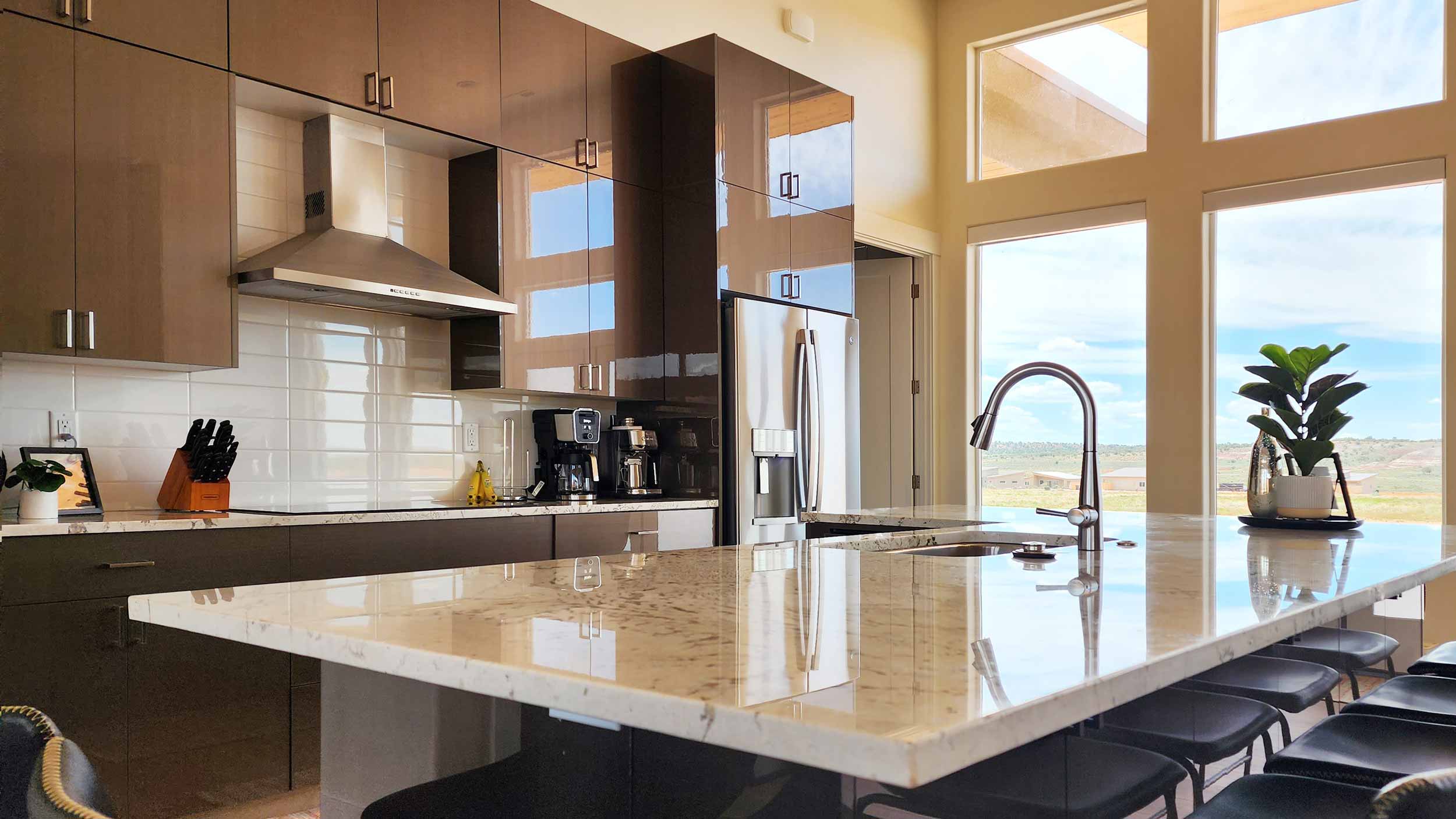

Quartz countertops are widely known for their durability, but understanding what that durability actually means is important when choosing a surface for a kitchen or bathroom renovation.
This Quartz Countertop Durability Guide explains how quartz performs under everyday conditions, including heat exposure, scratches, stains, and long-term wear. While many countertop materials are marketed as “durable,” each material behaves differently when exposed to cooking heat, heavy use, impacts, and daily household activity.
Durability affects how a countertop looks and performs over time. Surfaces that resist scratching, staining, and cracking tend to maintain their appearance longer and require fewer repairs or replacements. For homeowners comparing countertop options, understanding these durability characteristics helps set realistic expectations.
Quartz countertops are often chosen for their consistency and resistance to common types of damage. However, like any surface material, quartz has strengths and limitations. This guide explains how quartz performs in real-world environments so homeowners can determine whether it aligns with their durability expectations.
For a detailed look at where this material performs best in a home, see our Suitability Guide to Quartz Countertops: The Best (and Worst) Places to Install Quartz.
Countertop Durability Comparison
| Material | Heat Resistance | Scratch Resistance | Stain Resistance | Ease of Maintenance |
|---|---|---|---|---|
| Quartz | 3/5 | 4/5 | 5/5 | 5/5 |
| Granite | 5/5 | 4/5 | 3/5 | 3/5 |
| Quartzite | 5/5 | 5/5 | 3/5 | 3/5 |
| Marble | 4/5 | 2/5 | 2/5 | 2/5 |
| Dolomite | 4/5 | 3/5 | 3/5 | 3/5 |
How Durable Are Quartz Countertops?
Quartz countertops are generally considered one of the most durable countertop materials used in residential kitchens and bathrooms. Because quartz countertops are engineered rather than quarried as solid stone, they have consistent color, pattern, and structure throughout the slab. The presence of resin binders also creates a surface that is non-porous, meaning liquids cannot easily penetrate the material.
Several characteristics contribute to their durability:
- the hardness of natural quartz mineral
- the density created during manufacturing
- the non-porous structure created by resin binders
These properties make quartz surfaces highly resistant to:
- staining from common kitchen substances
- scratching during normal use
- moisture intrusion
However, quartz is not indestructible. The resin components that help bind the material together also influence how the surface reacts to heat and certain impacts.
Overall, quartz offers a balance of high stain resistance, strong scratch resistance, and long-term stability, which is why it is widely used in modern kitchens.
Heat Resistance
Quartz countertops have moderate heat resistance, but they are not designed to withstand extreme or prolonged heat exposure.
Quartz performs well under normal kitchen conditions but it is less heat tolerant than most natural stone countertops.
Unlike natural stone materials such as granite or quartzite, quartz slabs contain polymer resins. These resins help bind the quartz particles together and create a dense, non-porous surface. However, resin components can be sensitive to high temperatures.
Under normal cooking conditions, quartz handles heat exposure reasonably well. Brief contact with warm cookware or steam typically does not cause damage. However, placing very hot pots, pans, or baking trays directly on the surface can create serious potential problems.
Excessive heat can cause:
- resin discoloration
- surface scorching or dull spots
- thermal stress that may lead to cracking
Because of this, quartz manufacturers generally recommend avoiding direct placement of hot cookware on the countertop surface.
Scratch Resistance
Quartz countertops are highly scratch resistant, largely due to the hardness of natural quartz mineral.
Quartz ranks around 7 on the Mohs hardness scale, which places it above many common household materials.
This hardness allows quartz countertops to resist scratches from:
- utensils
- cookware
- ceramic dishes
- typical kitchen activity
Under normal residential use, scratches are uncommon. The dense structure of engineered quartz also helps prevent surface abrasion from everyday contact.
However, quartz countertops are not completely scratch-proof.
Hard materials such as knives, ceramic, or other heavy objects can scratch the surface if used with sufficient pressure.
Repeated cutting directly on the countertop may eventually produce visible wear. For this reason, we recommend that you use cutting boards to protect both the countertop surface and your knives.
Overall, quartz performs very well in terms of scratch resistance compared to many other countertop materials.
Stain Resistance
Quartz countertops are extremely resistant to staining, largely because the material is non-porous.
Unlike many natural stones, quartz does not contain microscopic pores that allow liquids to penetrate beneath the surface. This structure prevents many common household substances from soaking into the material.
Quartz typically resists stains from substances such as:
- coffee
- wine
- oils
- fruit juices
- tomato sauces
Because liquids remain on the surface rather than absorbing into the material, quartz countertops are less prone to permanent discoloration compared to porous stone surfaces.
However, certain substances may still cause surface discoloration if left in prolonged contact with the countertop. Strong dyes, highly pigmented liquids, or harsh chemicals can sometimes leave marks.
Despite these possibilities, quartz remains one of the most stain-resistant countertop materials available.
For information about routine care and stain prevention, see our Quartz Countertop Maintenance Guide.
Expected Lifespan
Quartz countertops are designed to provide long service life in residential kitchens and bathrooms.
Under typical household conditions, quartz surfaces often remain functional and visually stable for several decades. Many homeowners install quartz countertops with the expectation that they will last for the life of the kitchen.
Factors that influence lifespan include:
- quality of fabrication and installation
- cabinet support and structural stability
- exposure to extreme heat or impacts
- overall household usage patterns
Because quartz is engineered under controlled manufacturing conditions, the material tends to remain stable over time. It does not typically develop structural weaknesses related to natural fissures or mineral variations.
As long as the surface is protected from severe heat exposure and heavy impacts, quartz countertops can maintain their performance for many years.
Practical Durability Considerations
Although quartz is highly durable, a few practical habits can help maintain the surface and reduce the risk of damage.
Many homeowners adopt simple precautions such as:
- using cutting boards when preparing food
- placing trivets or heat pads under hot cookware
- avoiding heavy impacts along exposed edges
These practices are pretty standard with among countertop materials and help protect the surface from unnecessary stress.
It is also helpful to avoid exposing quartz surfaces to sudden temperature extremes, which may create thermal stress within the material.
These precautions do not reflect weaknesses in quartz but rather standard practices for maintaining long-term countertop performance.
When Quartz Is a Good Choice
Quartz countertops perform particularly well in kitchens that experience frequent everyday use.
Situations where quartz durability stands out include:
- households that want strong stain resistance
- kitchens with frequent food preparation
- bathrooms exposed to moisture and cosmetics
- families seeking a low-maintenance surface
Because quartz resists staining and scratching during normal use, it maintains a consistent appearance even in busy kitchens.
For homeowners prioritizing predictable performance and minimal surface wear, quartz is often considered a reliable countertop option.
When Durability May Be a Concern
Despite its strengths, quartz may not be ideal in certain durability scenarios.
The most significant limitation involves high heat exposure. Kitchens that regularly place extremely hot cookware directly on countertops may encounter issues with discoloration or surface damage.
Quartz surfaces may also be vulnerable to heavy edge impacts, particularly along sharp corners or thin overhangs.
In addition, some quartz surfaces can experience color changes when exposed to prolonged ultraviolet light, which is why quartz is typically recommended for indoor applications.
These limitations do not affect most residential kitchens but are worth considering when comparing countertop materials.
For a broader evaluation of advantages and limitations, see Pros and Cons of Quartz Countertops.
Key Takeaways
- The material is highly resistant to stains and scratches under normal household use.
- Quartz has moderate heat resistance, but very hot cookware should not be placed directly on the surface.
- With proper use, quartz countertops can last several decades in residential kitchens.
- Quartz performs especially well in kitchens that prioritize stain resistance.
Quartz remains one of the most widely used countertop materials because it balances strong durability with consistent manufacturing and reliable long-term performance.
Countertop Durability Comparison
For a full side-by-side breakdown of countertop materials, visit our Countertop Durability Comparison, where quartz, granite, quartzite, marble, and dolomite are evaluated using the same durability criteria.