
Introduction
Not all surfaces are created equal. In the world of stone fabrication, assuming a material works everywhere is a mistake that can lead to costly failures. While engineered products like quartz have strict environmental boundaries due to their resin binders, quartzite is a 100% natural metamorphic rock. Forged under intense geological heat and pressure, it offers a level of resilience that few other materials can match. Understanding where quartzite can or should be used is essential for homebuilders and renovators looking for a surface that combines the elegance of marble with the ruggedness of granite.
Quartzite Installation Suitability Scale
| Application | Suitability Rating | Primary Constraint |
| Outdoor Environments | High | Natural UV stability; resists fading and yellowing. |
| High-Heat Areas | High | Geologically forged; superior thermal resistance. |
| Indoor Kitchens | High | Granite-level durability with marble aesthetics. |
| Bathrooms & Wet Areas | High | Naturally dense and moisture resistant. |
| Vertical Accents | High | Ideal for high-impact, bookmatched feature walls. |
| Commercial Applications | High | Stands up to high-frequency use and abrasion. |
| Flooring Applications | Moderate | Requires specific finishes for slip resistance. |
Outdoor Suitability
UV Stability
Unlike engineered surfaces that rely on polymer binders, quartzite is a natural metamorphic stone and is generally unaffected by ultraviolet radiation. Sunlight does not degrade the mineral structure of the stone itself. However, surface sealers, finishes, or resins occasionally used during fabrication may weather over time with outdoor exposure.
Color Fading Potential
The visual integrity of quartzite remains intact even under direct, prolonged sunlight. Where lighter-colored engineered stones might yellow or turn amber, quartzite maintains its natural pigments. It is an ideal choice for poolside bars and sun-drenched patios.
Freeze / Thaw Conditions
Quartzite is typically a dense natural stone and often exhibits relatively low water absorption compared with many other natural stones. Lower absorption helps reduce the likelihood of freeze–thaw damage because less water can enter the stone’s pore structure. However, performance still depends on the specific slab, its micro-fractures or veining, and the quality of installation.
Long-Term Outdoor Performance
Quartzite is widely considered suitable for outdoor installations because its mineral composition tolerates sunlight, temperature changes, and weather exposure well. While it generally performs better outdoors than many engineered materials, long-term appearance and finish retention still depend on the specific stone, installation quality, and environmental conditions.
Recommendation: In outdoor installations, materials such as quartzite or granite are significantly better suited due to their natural weather resistance.
Kitchen Suitability
Food Preparation Areas
Quartzite is commonly reported to fall around 7 on the Mohs hardness scale, which makes it harder than many granites and substantially harder than marble. This hardness contributes to good scratch resistance in typical kitchen use. However, knives and other harder materials can still mark the surface, and quartzite countertops are usually sealed to reduce liquid absorption.
Busy Household Kitchens
For high-traffic kitchens, quartzite provides the aesthetic of a high-end luxury stone without the fragility of marble. It handles the rigors of a “working kitchen” where spills are common. For maintenance requirements, see our Quartzite Countertop Maintenance Guide.
Island Installations
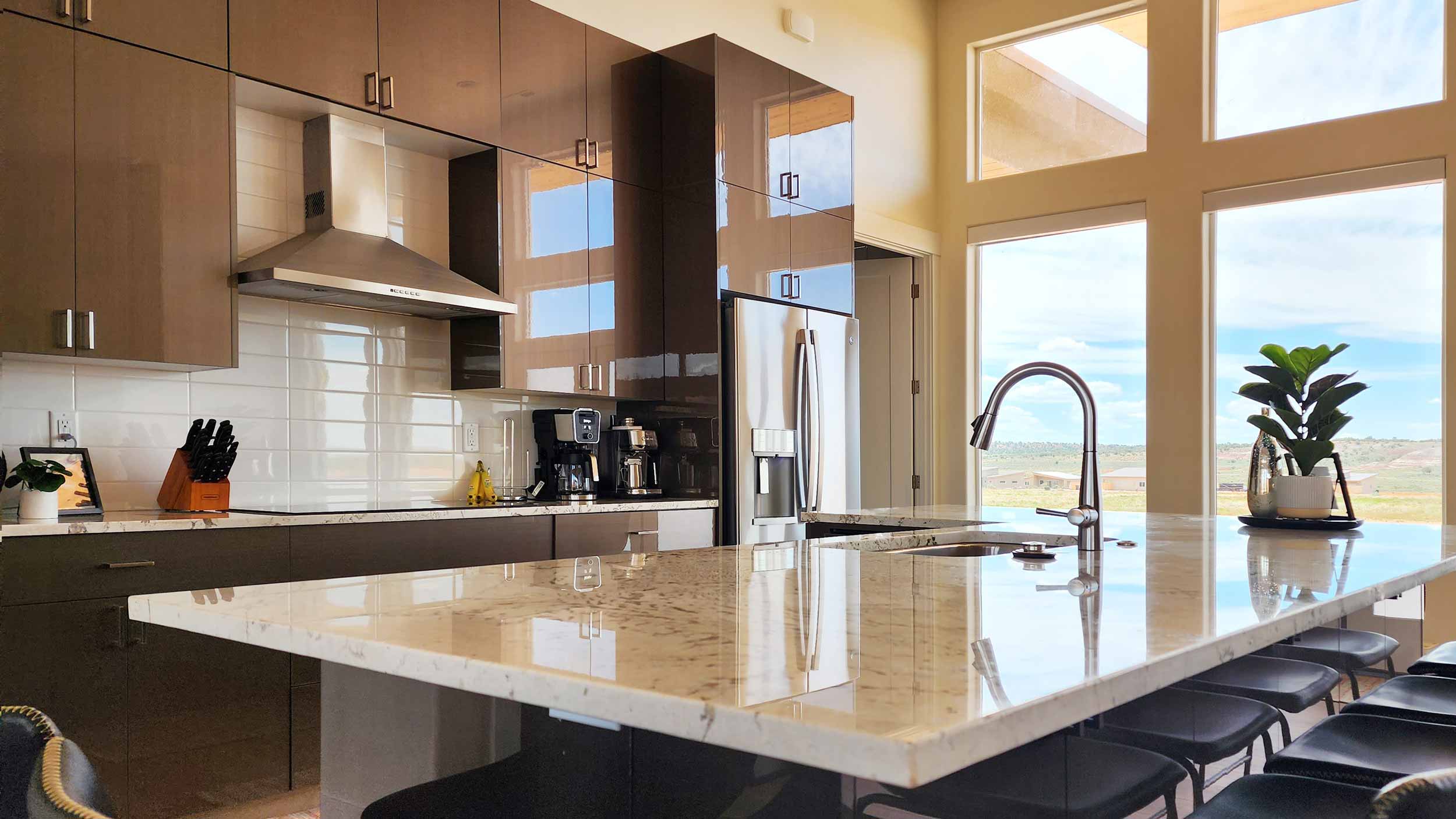
Quartzite is a favorite for large central islands due to its dramatic, flowing veining. While slabs do not come in the “jumbo” engineered sizes of quartz, their natural uniqueness makes them ideal for bookmatched installations where two slabs are mirrored to create a living work of art.
| Kitchen Type | Best Suited Materials | Key Advantage |
| Family / High Use | Quartz | Low maintenance and high impact resistance. |
| Gourmet / Chef’s | Quartzite, Granite | Superior heat tolerance for hot cookware. |
| Large Seamless Islands | Quartz | Availability of jumbo slabs. |
Recommendation: For indoor kitchen surfaces, quartz, granite, and quartzite are all excellent choices depending on specific durability and maintenance needs.
Bathroom and Wet-Area Suitability
Bathroom Vanity Installations
Quartzite is highly effective for vanities. It is naturally resistant to the high humidity and chemical exposure (such as perfumes and hairsprays) typical of bathroom environments.
Shower and Steam Room Environments
Unlike resin-based materials that can soften under constant steam, quartzite is geologically accustomed to high-heat and moisture environments. It is a safe and durable choice for shower benches, curbs, and wall cladding.
Hygiene and Sanitation
Because it is a natural stone, quartzite does have some porosity and requires sealing to remain perfectly hygienic. Once sealed, its surface is easy to sanitize and does not easily harbor mold or bacteria. For more on physical properties, see our Quartzite Countertop Durability Guide.
| Wet Area | Best Suited Material | Performance Note |
| Standard Vanity | Quartzite, Quartz | Quartz is practical. Quartzite is more aesthetic. |
| Steam Room | Quartzite, Granite | Resin-free stone handles sustained steam heat. |
| Shower Wall | Quartzite | Stunning natural veining with high durability. |
Recommendation: For bathrooms and wet areas, quartz and quartzite are top choices, though quartzite requires more specific care.
High-Heat Applications
Fireplace Surrounds
Quartzite is the “gold standard” for fireplace surrounds and hearths. It is geologically forged at temperatures far exceeding those produced by a residential fireplace. It can be used safely for “true” hearths that may come into contact with embers.
Sauna Installations
Quartzite is an excellent choice for saunas. Since it is a natural, resin-free stone, it does not off-gas when heated and handles the sustained thermal expansion of a sauna interior without bowing or cracking.
Outdoor Cooking Areas
Quartzite thrives near grills and pizza ovens. It can withstand the intense radiant heat that would melt or scorch engineered surfaces.
| Heat Source | Best Suited Materials | Risk Factor |
| Fireplace Hearth | Quartzite, Granite | Can safely contact high radiant heat. |
| Sauna Interior | Quartzite, Granite | No resins to off-gas or expand. |
| Outdoor Cooking Areas | Quartzite | Highest natural heat tolerance available. |
Recommendation: For high-heat areas, granite and quartzite offer superior thermal stability.
Commercial Applications
Restaurant Installations
Quartzite is frequently used in high-end dining environments. It provides a luxury aesthetic that can withstand the “back of house” heat and the “front of house” turnover.
High-Traffic Installations
In hotel lobbies or luxury retail, quartzite stands up to heavy use without developing the wear paths or “hollows” common in softer stones like marble. Its extreme hardness (Mohs 7) makes it highly resistant to the “clatter” of everyday commercial interaction.
| Commercial Use | Best Suited Materials | Performance Note |
| Bar Tops | Quartz | Scratch and stain resistance, no resealing. |
| Commercial Kitchens | Granite, Quartzite | High heat and heavy impact resistance. |
| Restaurant Tables | Quartz | Scratch and stain resistance, no resealing. |
| Reception Areas | Granite, Quartzite | Maintains luster under foot/hand traffic. |
| Retail Countertops | Quartz, Granite, Quartzite | Risk of staining is lower in retail space. |
Recommendation: For commercial use, quartz is excellent for front-of-house, while granite is a lower-cost option for heavy-duty kitchen work. Quartz, granite, and quartzite all have a place in commercial settings.
Flooring Applications
Slip Resistance
Quartzite is one of the most durable natural materials for flooring. However, polished quartzite is extremely slick when wet. For safety in wet areas or high-traffic zones, it is recommended to use a leathered, honed, or brushed finish to increase the coefficient of friction (COF).
Wear Patterns
Quartzite resists the abrasive force of foot traffic that can dull softer materials. Unlike engineered stone, it can be professionally refinished in place if it eventually loses its luster, though its natural hardness makes this a rare necessity.
Structural Considerations
As a natural stone, quartzite slabs are heavy and require a rigid subfloor. Because it is a 100% mineral product, it lacks the slight flexibility of resin-based materials and requires professional installation to prevent cracking over subfloor deflection.
Recommendation: For high-traffic flooring, quartzite offers high durability and natural slip resistance.
Vertical Applications
Backsplashes
Vertical applications are where quartzite truly shines. Using quartzite as a full-height backsplash creates a seamless, grout-free surface that is easy to wipe down and visually stunning.
Accent Walls
Quartzite is a favorite for decorative vertical features and monolithic accent walls. Its dramatic natural veining creates a “living art” effect that is often the focal point of primary suites or commercial lobbies. Like quartz, large vertical slabs require a mechanical fastening system due to their weight.
Moisture and Stain Exposure
Vertical quartzite in kitchens and baths is somewhat resistant to the splashing of oils or soaps. Because gravity prevents liquids from pooling, the risk of staining is much lower making it an appropriate vertical solution.
Recommendation: For vertical accents, quartz, granite, and quartzite can all provide stunning visual results with high performance.