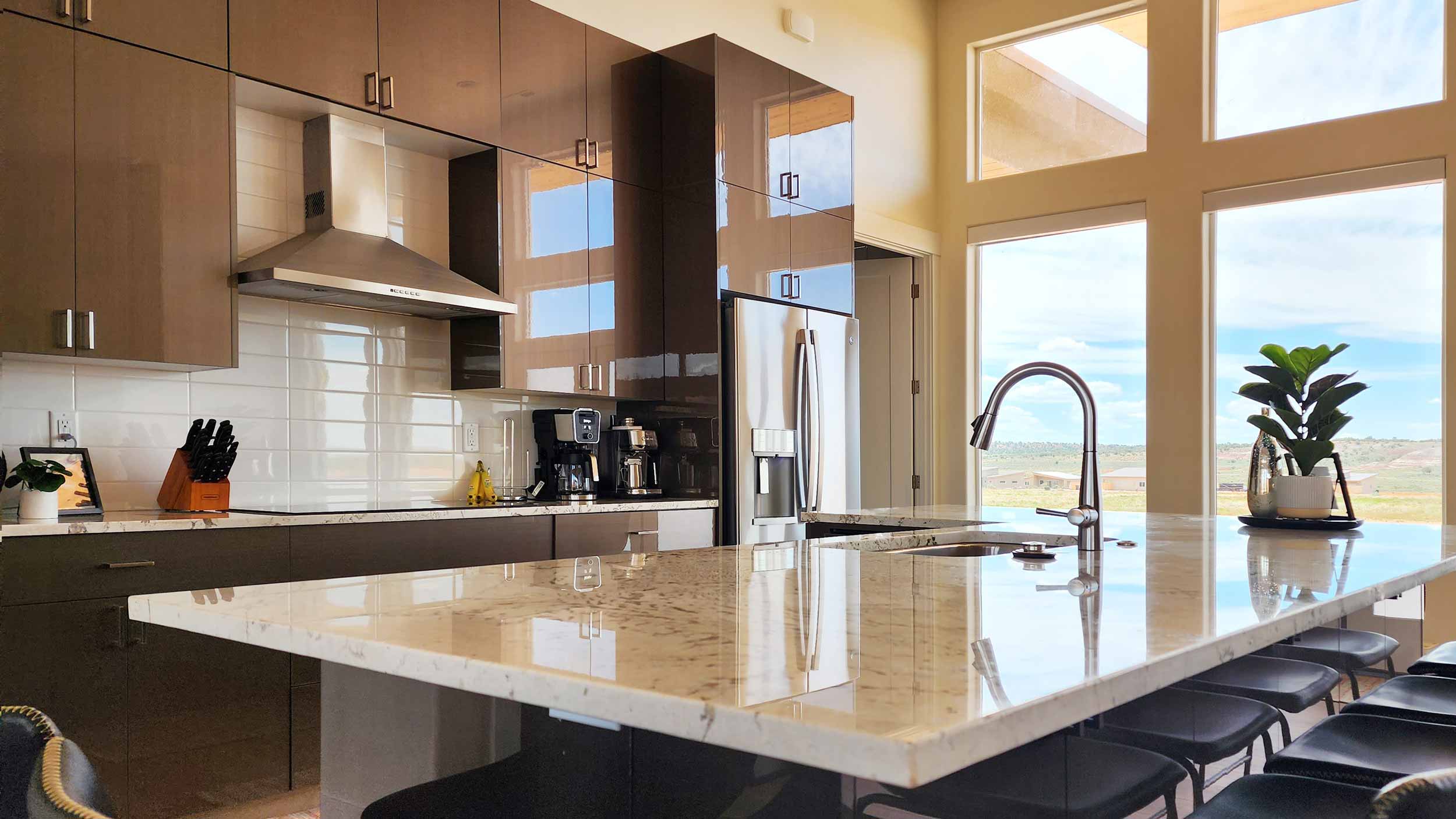

Quartzite countertops are often selected for their striking natural appearance, but durability is just as important as aesthetics when choosing a countertop material. This Quartzite Countertop Durability Guide explains how quartzite performs in everyday kitchen and bathroom environments, focusing on the material’s resistance to heat, scratches, stains, and long-term wear.
Countertops are exposed to a wide range of stresses during daily use. Cooking heat, sharp utensils, heavy cookware, and frequent spills all test the durability of a surface over time. Materials that resist these stresses effectively tend to maintain their appearance and structural integrity for many years.
Quartzite has developed a reputation as one of the hardest natural stones used for countertops, and its durability characteristics are often compared to granite. However, quartzite behaves differently from both granite and engineered materials such as quartz. Understanding these differences helps homeowners set realistic expectations about how the material will perform in a busy kitchen.
This guide focuses specifically on the durability and physical performance of quartzite countertops, allowing homeowners to evaluate whether the material aligns with their priorities for strength, longevity, and resistance to common forms of household wear.
For a detailed look at where this material performs best in a home, see our Suitability Guide to Quartzite Countertops: The Best (and Worst) Places to Install Quartzite.
Countertop Durability Comparison
| Material | Heat Resistance | Scratch Resistance | Stain Resistance | Ease of Maintenance |
|---|---|---|---|---|
| Quartz | 3/5 | 4/5 | 5/5 | 5/5 |
| Granite | 5/5 | 4/5 | 3/5 | 3/5 |
| Quartzite | 5/5 | 5/5 | 3/5 | 3/5 |
| Marble | 4/5 | 2/5 | 2/5 | 2/5 |
| Dolomite | 4/5 | 3/5 | 3/5 | 3/5 |
How Durable Are Quartzite Countertops?
Quartzite countertops are generally considered one of the most durable natural stone surfaces used in residential kitchens. Some varieties of quartzite resemble marble in appearance but have very different durability characteristics. The high quartz content gives quartzite much greater hardness than marble, which contributes to its reputation as a durable countertop material.
Several natural properties contribute to this durability:
- a dense crystalline structure
- high quartz mineral content
- strong resistance to heat
These characteristics allow quartzite to perform well in areas such as:
- scratch resistance
- heat tolerance
- structural stability
Quartzite is often compared to granite in terms of durability, and in many cases it is equally hard or even harder than granite.
However, quartzite is still a natural stone and therefore contains microscopic pores in its structure. These pores can allow liquids to penetrate the stone under certain conditions, which influences its resistance to staining.
Overall, quartzite combines exceptional hardness with strong resistance to heat and wear, making it a durable option for many kitchen environments.
Heat Resistance
Quartzite countertops offer excellent heat resistance, largely due to their mineral composition.
The stone is composed primarily of quartz crystals that formed under extreme geological heat and pressure. As a result, quartzite tolerates high temperatures well and generally performs reliably in cooking environments.
Placing hot cookware on quartzite surfaces typically does not cause immediate structural damage. The stone’s crystalline structure allows it to withstand temperatures that would damage many engineered materials.
However, sudden and extreme temperature changes may create thermal stress within the stone. While this is uncommon in typical kitchen environments, abrupt temperature shifts could theoretically affect the material over time.
In practice, quartzite’s heat tolerance is considered very strong compared to most countertop materials, making it suitable for kitchens where cooking heat is frequently present.
Scratch Resistance
Quartzite is widely regarded as one of the hardest countertop materials available.
The stone is composed largely of quartz mineral, which ranks around 7 on the Mohs hardness scale. Because quartzite contains tightly bonded quartz crystals, the stone often demonstrates very high resistance to scratching.
During normal kitchen use, quartzite countertops resist scratches from:
- utensils
- cookware
- ceramic dishes
- common kitchen tools
This hardness allows quartzite to maintain its polished surface even in kitchens that experience frequent food preparation.
In some cases, quartzite may even be harder than granite, depending on the specific stone variety.
Despite this strength, quartzite is not completely immune to scratching. Hard objects used with sufficient force could still create surface marks. Repeated cutting directly on the countertop may also leave subtle wear patterns over time.
Overall, quartzite performs exceptionally well in terms of scratch resistance compared to most natural stone countertop materials.
Stain Resistance
Quartzite’s stain resistance depends on the density and porosity of the specific stone slab.
Like most natural stones, quartzite contains microscopic pores that can allow liquids to penetrate the surface. This means certain substances may be absorbed into the stone if they remain on the countertop for extended periods.
Common kitchen substances that may interact with quartzite include:
- cooking oils
- coffee
- wine
- fruit juices
- tomato-based sauces
When these substances remain on the surface long enough, they may penetrate the stone and create discoloration.
However, many quartzite varieties are relatively dense and resistant to liquid absorption, which helps reduce staining risks compared to softer natural stones.
The degree of stain resistance varies depending on the geological characteristics of the particular slab.
For information about daily care and surface protection, see our Quartzite Countertop Maintenance Guide.
Expected Lifespan
Quartzite countertops are known for their long lifespan in residential environments.
Because the stone is composed of dense quartz crystals with strong mineral bonds, it can maintain structural integrity for many years. In many homes, quartzite countertops remain functional and visually stable for several decades or longer.
Factors that influence lifespan include:
- the density and composition of the specific quartzite slab
- fabrication quality
- structural support from cabinetry
- the intensity of daily kitchen use
Quartzite’s crystalline structure allows it to resist many forms of wear that affect softer stones. The surface typically maintains its strength and appearance over extended periods.
As a result, quartzite countertops are often installed with the expectation that they will last for the life of the kitchen.
Practical Durability Considerations
Even though quartzite is extremely durable, certain everyday practices can help minimize wear and reduce the risk of damage.
Common precautions include:
- using cutting boards when preparing food
- avoiding heavy impacts along exposed edges
- using heat pads or trivets when placing very hot cookware
These practices help prevent unnecessary stress on the surface and preserve the appearance of the stone.
Quartzite is highly resistant to scratching and heat, but minimizing direct impacts and prolonged contact with staining substances can help maintain the surface over time.
When Quartzite Is a Good Choice
Quartzite performs particularly well in kitchens that require high resistance to heat and surface scratching.
Situations where quartzite durability stands out include:
- kitchens with frequent cooking activity
- households that use heavy cookware
- homeowners seeking a natural stone with exceptional hardness
- kitchens where long-term structural durability is important
Quartzite is often chosen by homeowners who want the appearance of natural stone combined with durability characteristics that rival or exceed granite.
To explore available styles and colors, see our collection of Quartzite countertops.
When Durability May Be a Concern
Despite its strength, quartzite does have some durability considerations.
The most notable limitation is liquid absorption. Because quartzite is a natural stone with microscopic pores, certain liquids may penetrate the surface under prolonged exposure.
Quartzite countertops may also experience edge chipping if the stone is struck by heavy objects. While this risk is not unique to quartzite, it is a common characteristic of natural stone countertops.
Additionally, the durability of quartzite can vary depending on the specific stone variety. Some stones marketed as quartzite may contain minerals that behave differently from true quartzite, which can influence performance.
Understanding these factors helps homeowners evaluate whether quartzite aligns with their expectations for long-term durability.
For a broader overview of advantages and limitations, see Pros and Cons of Quartzite Countertops.
Key Takeaways
- The stone is extremely hard, making it highly resistant to scratching during normal kitchen use.
- Quartzite offers excellent heat resistance, allowing it to tolerate hot cookware better than many engineered materials.
- Because quartzite is a natural stone with microscopic pores, certain liquids may penetrate the surface under prolonged exposure.
- Edge impacts can occasionally cause chipping, particularly along exposed corners.
- With normal residential use, quartzite countertops can remain functional and attractive for several decades.
Quartzite is often chosen for its combination of natural beauty and exceptional hardness, making it one of the most durable natural stone countertop materials available for residential kitchens.
Countertop Durability Comparison
For a full side-by-side breakdown of countertop materials, visit our Countertop Durability Comparison, where quartz, granite, quartzite, marble, and dolomite are evaluated using the same durability criteria.