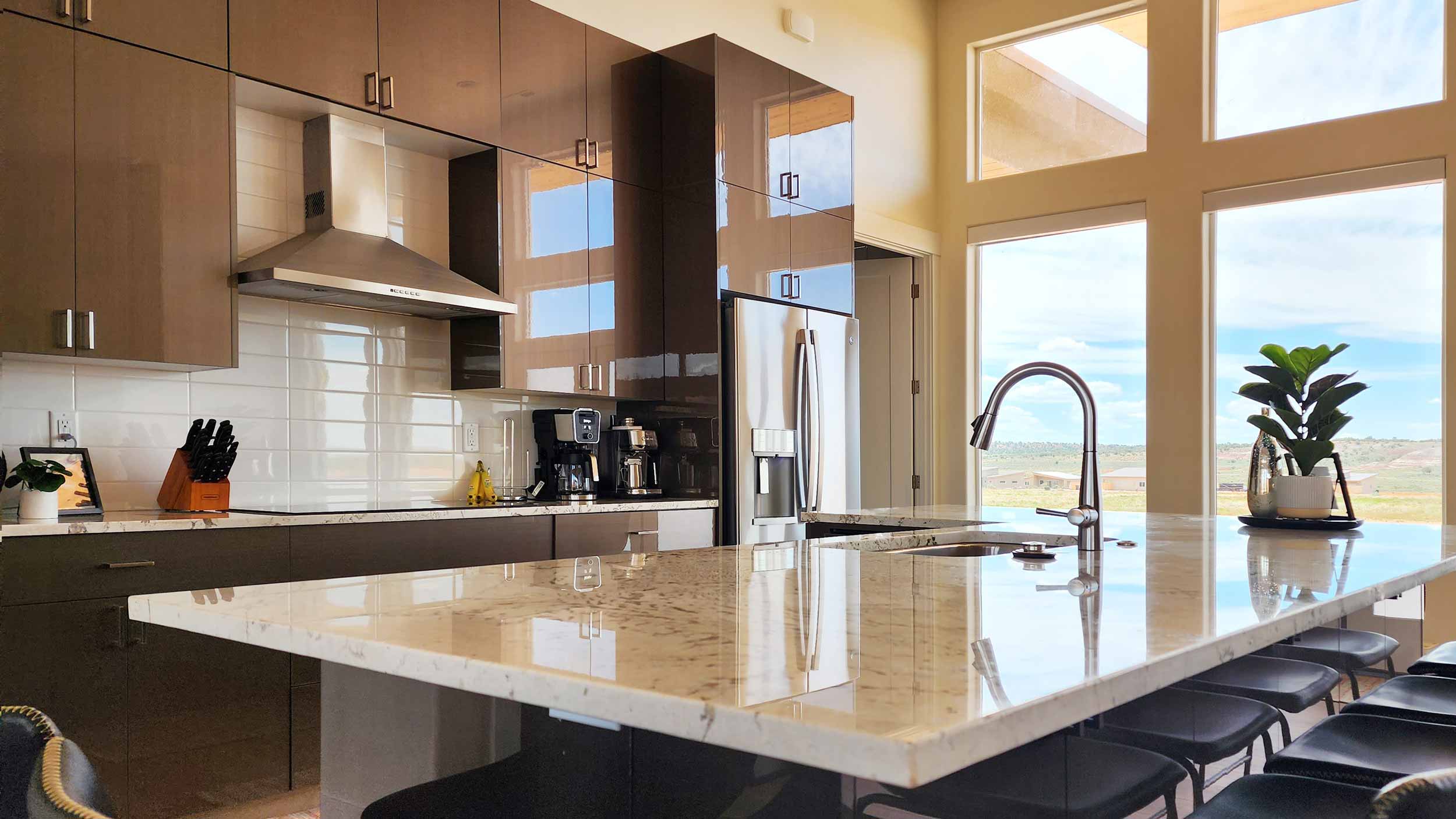

Granite countertops are widely known for their strength and longevity, but understanding exactly how granite performs over time is important when selecting a countertop material. This Granite Countertop Durability Guide explains the physical performance characteristics of granite, including how it responds to heat, scratches, stains, and impact.
Durability is one of the most important factors homeowners consider when choosing a countertop surface. Kitchens and bathrooms expose countertops to daily stress such as hot cookware, sharp utensils, spills, and general wear. A durable material maintains its structural integrity and appearance despite this repeated use.
Granite countertops have long been regarded as one of the most durable natural stone options. Its mineral composition gives it exceptional hardness and heat tolerance, which is why it has been used in construction and architectural applications for centuries. However, like any natural material, granite has both strengths and limitations that homeowners should understand before choosing it for a renovation.
This guide focuses specifically on granite’s durability characteristics, and should help you understand how the material performs in real-world kitchen and bathroom environments.
For a detailed look at where this material performs best in a home, see our Suitability Guide to Granite Countertops: The Best (and Worst) Places to Install Granite.
Countertop Durability Comparison
| Material | Heat Resistance | Scratch Resistance | Stain Resistance | Ease of Maintenance |
|---|---|---|---|---|
| Quartz | 3/5 | 4/5 | 5/5 | 5/5 |
| Granite | 5/5 | 4/5 | 3/5 | 3/5 |
| Quartzite | 5/5 | 5/5 | 3/5 | 3/5 |
| Marble | 4/5 | 2/5 | 2/5 | 2/5 |
| Dolomite | 4/5 | 3/5 | 3/5 | 3/5 |
How Durable Are Granite Countertop?
Granite countertops are generally considered one of the most durable natural countertop materials available. Its natural strength and resistance to heat and cold make granite particularly well suited to environments where countertops are exposed to frequent cooking activity or outdoor elements.
Several natural properties contribute to granite’s durability:
- high mineral hardness
- strong crystalline structure
- excellent resistance to heat
These characteristics allow granite to withstand many of the conditions that countertops experience in daily use, indoors and outdoors.
Compared to many other materials, granite performs very well in areas such as:
- heat resistance
- scratch resistance
- structural stability
However, granite is also a naturally porous material, which means it can absorb liquids if the surface is not protected. This characteristic affects how the stone responds to spills and staining.
Overall, granite is known for its ability to maintain structural integrity and appearance over long periods of time when used in typical residential environments.
Heat Resistance
One of granite’s strongest durability characteristics is its exceptional heat resistance.
Because granite forms from molten rock deep within the earth, the stone naturally tolerates high temperatures. Granite countertops can generally handle heat exposure from cookware without experiencing structural damage.
Placing hot pots or pans on granite surfaces typically does not cause the type of discoloration or scorching that can occur with some engineered materials. The mineral composition of granite allows it to withstand high temperatures without melting or softening.
However, sudden and extreme temperature changes can sometimes create thermal stress within the stone. For example, placing extremely hot cookware onto a very cold countertop surface could theoretically create stress.
In most residential kitchens, granite’s heat tolerance is considered excellent compared to many other countertop materials.
Scratch Resistance
Granite is also highly resistant to scratching due to the hardness of the minerals that compose the stone.
Many granite slabs contain a large proportion of quartz and feldspar, minerals that rank relatively high on the Mohs hardness scale. This hardness makes granite resistant to abrasion and surface scratching during everyday kitchen use.
Under normal conditions, granite countertops can resist scratches from:
- utensils
- cookware
- dishes
- general kitchen activity
It is even possible to cut food directly on granite surfaces without immediately damaging the stone. However, repeated cutting directly on the countertop may eventually dull knives and could leave faint marks over time.
While granite is very hard, it is not completely scratch-proof. Extremely hard materials or sharp tools used with sufficient pressure could still create scratches on the surface.
Overall, granite performs very well in terms of scratch resistance and is considered suitable for high-use kitchen environments.
Stain Resistance
Granite’s stain resistance depends largely on the porosity of the individual stone slab.
Unlike engineered materials such as quartz, granite is a natural stone with microscopic pores in its structure. These pores can allow certain liquids to penetrate the surface under some conditions.
Common kitchen substances that may interact with granite include:
- oils
- wine
- coffee
- fruit juices
- sauces
If these liquids remain on the surface long enough, they may be absorbed into the stone and potentially cause discoloration.
The degree of stain resistance can vary depending on the specific type of granite. Some granite varieties are relatively dense and resist liquid absorption well, while others are more porous.
Although granite is capable of absorbing liquids, it generally resists staining better than many softer natural stones.
For information about routine care and surface protection, see our Granite Countertop Maintenance Guide.
Expected Lifespan
Granite countertops are known for their long lifespan in residential environments.
Because granite is a dense natural stone with strong mineral bonds, it can maintain structural integrity for decades. Many granite countertops installed in homes continue performing well for 30 years or longer.
Factors that influence the lifespan of granite countertops include:
- the quality of the stone
- fabrication accuracy
- structural support from cabinetry
- the intensity of household use
Unlike some engineered materials, granite does not rely on synthetic binders that may degrade over time. Its mineral composition remains stable under normal conditions.
As a result, granite countertops are often considered a long-term investment that can last as long as the kitchen itself.
Practical Durability Considerations
Although granite is extremely durable, a few simple practices can help reduce the risk of damage during daily use.
Many homeowners adopt practical habits such as:
- using cutting boards for food preparation
- avoiding heavy impacts on countertop edges
- placing heat pads or trivets under very hot cookware
These precautions help protect the countertop from unnecessary stress and preserve its appearance over time.
Granite’s natural hardness allows it to tolerate substantial use, but minimizing sharp impacts and prolonged exposure to staining substances can help maintain the surface for many years.
When Granite Is a Good Choice
Granite countertops are particularly well suited for environments that demand strong heat resistance and structural durability.
Situations where granite performs especially well include:
- kitchens where hot cookware is frequently used
- households with heavy cooking activity
- outdoor kitchens exposed to sunlight and heat
- homeowners seeking a long-lasting natural stone surface
Because granite tolerates high temperatures and everyday kitchen wear, it is often chosen for kitchens that experience frequent cooking and food preparation.
For homeowners who want a countertop material with strong heat tolerance and natural stone durability, granite is often a practical option.
To explore available styles and colors, see our collection of Granite countertops.
When Durability May Be a Concern
Despite its strength, granite does have some durability considerations.
The most notable limitation involves liquid absorption. Because granite is porous, certain liquids may penetrate the surface if they remain on the stone long enough.
Granite may also be susceptible to edge chipping if the countertop is struck by heavy objects.
In addition, natural fissures present in some slabs can influence how the stone responds to impact or stress, although these features are typically cosmetic rather than structural.
Understanding these characteristics helps homeowners set realistic expectations about granite’s long-term performance.
For a broader overview of advantages and limitations, see Pros and Cons of Granite Countertops.
Key Takeaways
- The material offers excellent heat resistance, making it well suited to cooking environments.
- Granite is highly scratch resistant due to its hard mineral composition.
- Because granite is porous, certain liquids may penetrate the stone under some conditions.
- With normal residential use, granite countertops can last several decades or longer.
Granite remains one of the most widely used natural stone countertop materials because it combines strong structural durability with the unique visual characteristics of quarried stone.=
Countertop Durability Comparison
To see how this material compares with other countertop options, review our Countertop Durability Comparison, which evaluates heat resistance, scratching, staining, and maintenance expectations across several common materials.