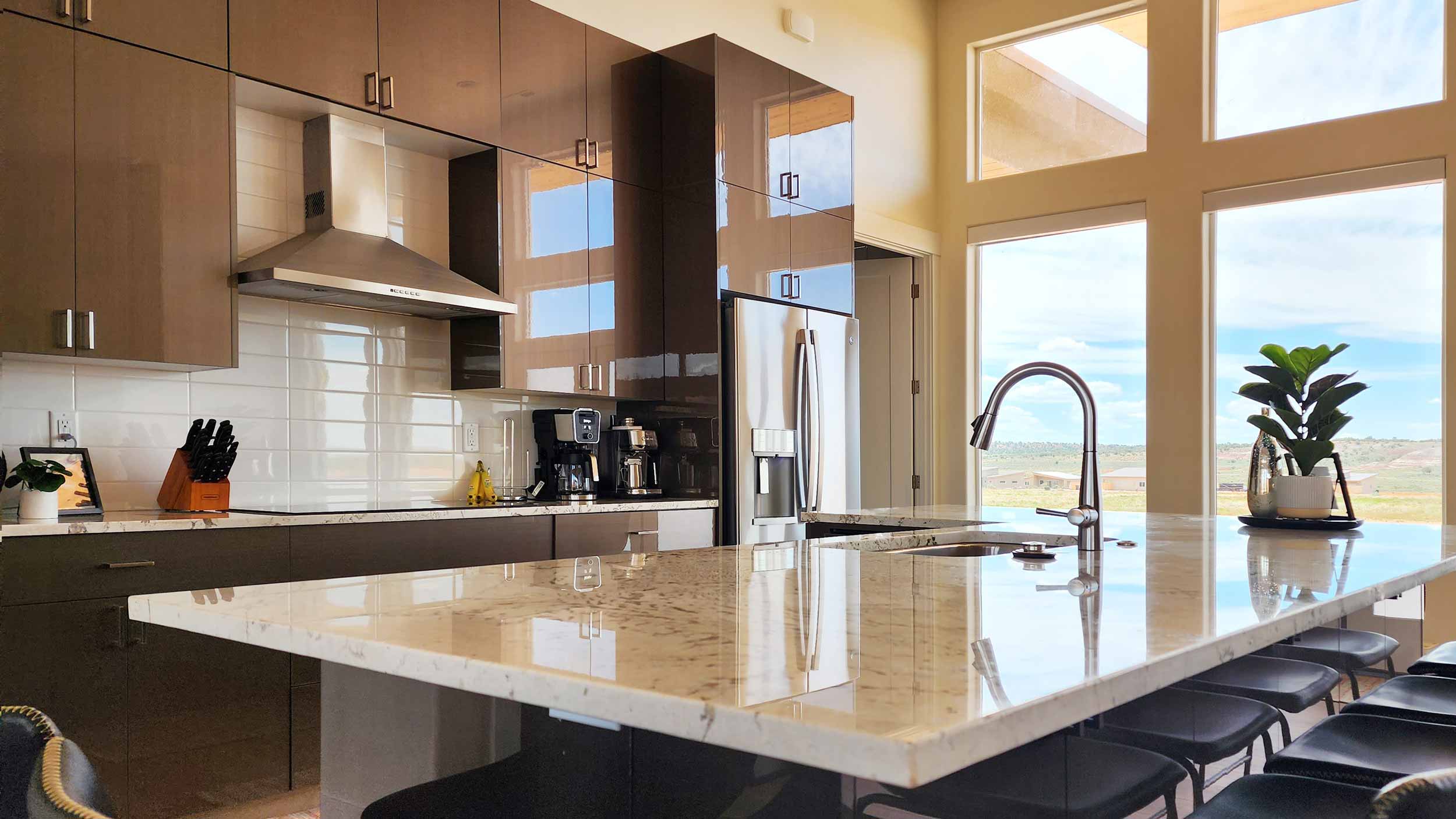

Granite countertops have been used in residential kitchens for decades and remain one of the most recognizable natural stone options. Understanding the pros and cons of granite countertops will help you decide whether the material aligns with your needs and expectations. Some homeowners prefer engineered materials with more predictable patterns or lower maintenance expectations.
This guide explains the advantages and limitations of granite countertops so you can decide whether granite fits your design goals, cooking habits, and maintenance preferences.
| Category | Rating | What It Means |
|---|---|---|
| Durability | 4/5 | Very hard, performs well in most kitchens. |
| Ease of Maintenance | 3/5 | Periodic sealing is necessary. |
| Heat Resistance | 5/5 | Tolerates high temperatures very well. |
| Scratch Resistance | 4/5 | Resists most kitchen abrasion. |
| Stain Resistance | 3/5 | Periodic sealing is necessary. |
Choosing Granite Countertops: What Matters Most
Why Choose Granite Countertops?
Granite countertops are often chosen for authentic natural stone durability and geological character. Because granite forms naturally in the earth, every slab is unique, which appeals to those who prefer natural materials over engineered surfaces.
The Primary Benefit of Granite:
Granite performs extremely well in demanding kitchens and handles high cooking temperatures comfortably. This durability is one reason granite has remained popular for residential kitchens for decades. Granite is one of the most scratch-resistant countertop materials commonly used in kitchens. The stone’s hardness makes scratching under normal use unlikely.
The Primary Drawback of Granite:
Granite is a natural stone that contains microscopic pores, so periodic sealing is recommended to maintain stain resistance.
What Are Granite Countertops?
Granite countertops are made from natural stone that is quarried from the earth and cut into slabs for use in kitchens and bathrooms. The stone is then polished and fabricated into countertops.
Because granite forms naturally, every slab is different. This natural variation is one reason granite countertops remain popular for kitchens where authentic stone and unique character are desired.
Advantages of Granite Countertops
Granite countertops offer several strengths that make them appealing for many kitchens. Most advantages relate to natural appearance, heat tolerance, and long-term durability.
Subtle Variation
One of the biggest reasons homeowners choose granite is its unique natural variation.
Because granite forms underground through geological processes, no two slabs look exactly the same. Granite is generally pretty uniform, but mineral movement, crystal structures, and color variations create patterns that cannot be replicated precisely.
For homeowners who want the countertop to be a visual focal point of the kitchen, granite can provide a striking and distinctive surface.
Natural Material Appeal
Granite is quarried directly from the earth and cut into slabs before being polished and fabricated.
For some, the appeal of granite is philosophical as well as visual. Choosing granite allows them to incorporate a natural geological material into the kitchen rather than an engineered surface.
This authenticity is one reason granite continues to be popular even as engineered materials have grown more common.
Heat Tolerance in Daily Cooking
Cooking habits often influence countertop material decisions. Homeowners who frequently move hot cookware directly from the stove or oven to the countertop often prefer natural stone surfaces that tolerate heat comfortably.
Granite countertops handle high temperatures well during everyday kitchen use because the stone formed under intense geological heat and pressure. Many households still use trivets as a precaution, but granite generally feels forgiving when dealing with hot cookware.
For a deeper explanation of how granite performs under heat and everyday wear, see the Granite Countertop Durability Guide.
Wide Range of Colors and Patterns
Granite comes in a wide variety of colors and patterns depending on where the stone was quarried.
Common styles include:
- subtle speckled patterns
- dramatic mineral movement
- bold contrasting veins
- soft neutral tones
Because of this variation, granite can work well in both traditional and contemporary kitchens.
Some homeowners specifically choose granite because they want a countertop surface that feels organic and visually dynamic.
Durability
Granite countertops have been widely installed in kitchens for many years. Because of this long history, the material has developed a reputation for durability and long-term reliability.
Granite is commonly associated with:
- custom homes
- traditional kitchens
- high-end residential renovations
Suitable for Outdoor Kitchens
Granite performs well in outdoor environments compared with most other countertop materials.
Because it is natural stone, granite can tolerate sunlight and weather exposure in ways that most engineered materials cannot.
For homeowners planning:
- outdoor kitchens
- patio cooking areas
- grill stations
granite is often a practical choice.
Potential Drawbacks
Although granite countertops offer many advantages, homeowners should also consider several tradeoffs when evaluating materials.
Periodic Sealing Requirements
Granite is a natural stone that contains microscopic pores that can absorb liquids. For this reason, granite countertops are typically sealed during installation and resealed periodically to help maintain stain resistance.
If you want a surface that doesn’t require that kind of maintenance, you may prefer quartz countertops.
Homeowners interested in care instructions can review the Granite Countertop Maintenance Guide.
Slab Variation Can Make Design Planning Harder
One of granite’s biggest advantages—its uniqueness—can also create design challenges.
Because every slab is different:
- the slab in a showroom may not match the slab installed in the kitchen
- multiple slabs may vary slightly from each other
- designers must plan layouts carefully
We generally encourage buyers to visit the stone yard and select their exact slab before fabrication begins.
Matching Granite Later Can Be Difficult
Because granite slabs are unique, matching an existing countertop later can be challenging.
If a kitchen renovation expands years later or a section of countertop needs replacement, the original quarry batch may no longer be available.
This is rarely a problem in the short term, but it can matter for homeowners planning phased renovations.
Maintenance Expectations
Granite maintenance is generally manageable, but it is not completely maintenance-free.
Homeowners who prefer surfaces that require very little attention sometimes choose engineered materials like quartz instead.
Granite owners typically become familiar with simple habits such as:
- periodic sealing
- wiping spills promptly
- avoiding harsh cleaning chemicals
These expectations are manageable for most households but still represent a small additional responsibility.
Ideal Use Cases
Granite countertops tend to work particularly well in kitchens where natural materials and visual character are priorities.
Granite is often a strong fit for:
- homeowners who want unique slabs
- traditional or transitional kitchen designs
- households that cook frequently
- outdoor kitchen installations
- kitchens where natural stone is part of the design theme
Granite is also commonly used in bathrooms, laundry rooms, and other interior spaces throughout the home.
For a detailed look at where this material performs best in a home, see: The Best (and Worst) Places to Install Granite.
Situations Where Another Material May Be Better
Although granite works well in many kitchens, other materials may be more appropriate depending on a homeowner’s priorities.
Engineered materials may be preferable when homeowners want:
- countertops that do not require periodic sealing (see: quartz)
- absolutely-predictable appearance across multiple slabs (see: quartz)
In practice, most people will choose between granite and quartz materials based on lifestyle priorities.
Granite buyers often prioritize:
- natural geological materials
- unique one-of-a-kind slabs
- traditional stone aesthetics
- low-cost options compared to premium stones like quartzite, or marble
Countertop Durability Comparison
If you’re comparing multiple materials, our Countertop Durability Comparison provides a side-by-side look at how quartz, granite, quartzite, marble, and dolomite perform under everyday kitchen conditions.