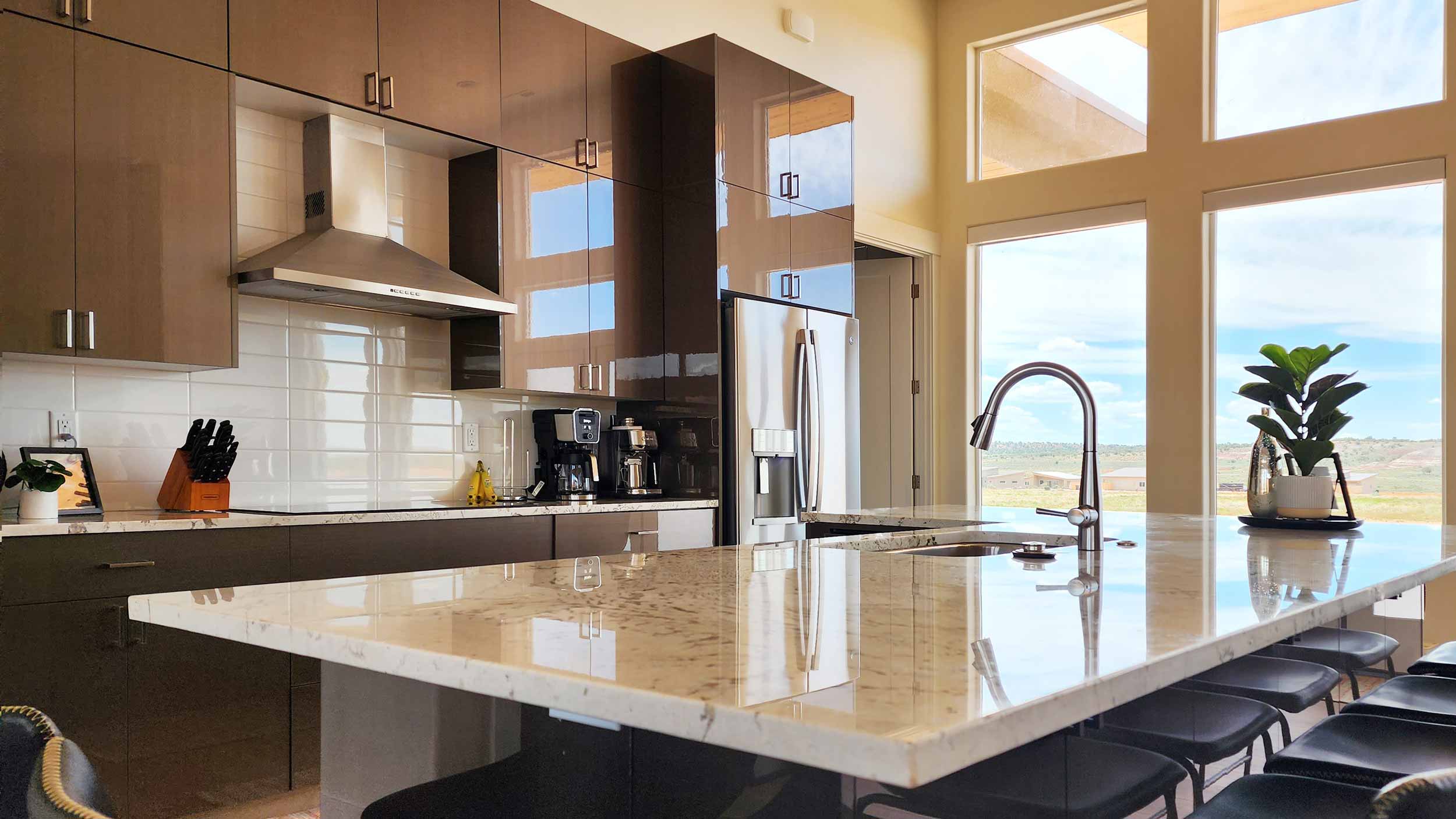

Understanding the pros and cons of quartz countertops will help you decide whether the material aligns with your needs and expectations. Countertops influence both the appearance of the kitchen and how the space functions during everyday cooking, so the decision affects design, maintenance expectations, and long-term practicality.
Quartz countertops have become one of the most commonly installed surfaces in modern homes. Many homeowners choose quartz because it offers predictable patterns, relatively simple upkeep, and a wide range of design options. At the same time, quartz is not automatically the best material for every kitchen.
| Category | Rating | What It Means |
|---|---|---|
| Durability | 4/5 | Resists everyday wear. |
| Ease of Maintenance | 5/5 | No sealing required, only simple cleaning. |
| Heat Resistance | 3/5 | Can be damaged by very hot cookware. |
| Scratch Resistance | 4/5 | Resist most everyday scratching. |
| Stain Resistance | 5/5 | Non-porous surface. |
Choosing Quartz Countertops: What Matters Most
Why Choose Quartz Countertops?
Quartz countertops are commonly chosen when low maintenance and predictable design are the top priorities. Because quartz is engineered, colors and patterns remain consistent across slabs, which simplifies kitchen design and planning.
The Primary Benefit of Quartz:
Quartz performs reliably in busy kitchens and requires very little upkeep. The surface is non-porous, so sealing is not required, and routine cleaning is simple. Quartz is highly scratch resistant and performs well in everyday kitchen use.
The Primary Drawback of Quartz:
Quartz contains resin binders that can be burnt at high temperatures, so very hot cookware cannot be placed directly on the surface. For this reason, trivets or hot pads are a necessity.
What Are Quartz Countertops?
Quartz countertops are engineered surfaces made from natural quartz minerals combined with binding resins. Because the material is manufactured rather than quarried, the color and pattern of quartz slabs can be controlled during production.
This manufacturing process is one reason quartz countertops are often chosen for kitchens where consistent color, predictable patterns, and low maintenance are important considerations.
Advantages of Quartz Countertops
Quartz countertops offer several strengths that make them a practical choice for many kitchens. Most advantages relate to predictable appearance, manageable maintenance, and design flexibility.
Consistent Appearance
One of the most common reasons homeowners choose quartz is its pattern consistency.
Because quartz slabs are manufactured:
- colors remain predictable from slab to slab
- patterns repeat consistently across installations
- kitchens can be designed around a reliable sample
This consistency simplifies the design process, especially in kitchens with long countertop runs or large islands.
Homeowners who want their finished kitchen to closely match the showroom sample often find quartz appealing for this reason.
Wide Range of Design Options
Quartz manufacturers produce a wide variety of styles.
Common options include:
- marble-inspired veining
- subtle stone-like textures
- soft neutral colors
- solid modern tones
Because of this range, quartz works well across many design styles:
- modern kitchens
- transitional interiors
- minimalist spaces
- contemporary renovations
Quartz is particularly popular in kitchens where designers want a clean, cohesive look across large surfaces.
No Sealing Required
One of the most practical advantages of quartz is that it does not require periodic sealing.
Many natural stone countertops require sealing to maintain stain resistance. Quartz, by contrast, is non-porous due to its engineered structure.
For homeowners, this means:
- no sealing schedule to manage
- fewer maintenance concerns
- simpler long-term care expectations
Many homeowners choose quartz specifically because it does not require periodic sealing. Natural stone countertops (granite, marble, quartzite, and dolomite) typically require sealing to maintain stain resistance, while quartz surfaces remain non-porous without additional treatments.
Homeowners interested in daily cleaning and care recommendations can review the Quartz Countertop Maintenance Guide.
Resistance to Surface Reactions from Acidic Ingredients
In everyday kitchens, ingredients such as citrus juice, vinegar, wine, and tomato products are common.
Certain natural stones can react with acidic substances, leaving visible marks on the surface. Quartz does not experience this type of surface reaction.
For households that cook frequently with acidic ingredients, quartz can feel like a lower-stress surface during daily cooking.
Flexible Cost Range
Quartz countertops are often perceived as expensive, but the price range varies widely depending on the product selected.
In practice:
- some quartz options cost less than many granite slabs
- mid-range quartz falls near common natural stone pricing
- designer quartz patterns can be more expensive
Quartz is also available in multiple slab thicknesses.
We frequently use 2 cm slabs with mitered edges to create the appearance of a thicker countertop. This technique allows homeowners to achieve a substantial design while managing overall project cost.
Quartz is also well suited for dramatic features such as:
- waterfall islands
- thick contemporary edge profiles
- large continuous surfaces
Easier Long-Term Matching
Because quartz patterns are manufactured consistently, matching additional material later is often easier than with natural stone.
If a kitchen is expanded or modified in the future:
- quartz slabs are more likely to match
- replacement pieces can be easier to source
Natural stone slabs, by contrast, are always unique, which can make matching older installations more difficult.
Potential Drawbacks
Although quartz countertops offer many advantages, there are also tradeoffs homeowners should consider.
Understanding these limitations helps ensure the material matches the way a kitchen will actually be used.
Less Natural Variation
Quartz patterns are engineered rather than formed naturally underground.
While many designs mimic natural stone, the patterns are still manufactured.
Homeowners who prefer dramatic geological movement often prefer materials such as:
In very large islands, certain quartz patterns may also repeat more noticeably than natural stone patterns.
Not Suited to Outdoor-Focused Applications
Quartz countertops are generally intended for indoor installations.
Extended exposure to direct sunlight can affect the resins used in quartz manufacturing.
For outdoor kitchens or grill areas exposed to sun, natural stone materials are typically a better fit.
Heat Tolerance and Everyday Cooking Habits
Different countertop materials respond differently to heat during everyday cooking. Homeowners who frequently move hot cookware directly from the stove or oven to the countertop sometimes prefer surfaces that tolerate direct heat more comfortably.
Quartz countertops perform well in most residential kitchens, but because the material contains binding resins, very high temperatures can damage the surface. For this reason, you must absolutely use trivets or hot pads when placing hot cookware on quartz countertops.
Homeowners who regularly move hot pans directly onto the countertop may feel more comfortable with natural stone surfaces. For a deeper explanation of how quartz behaves under daily wear, see the Quartz Countertop Durability Guide.
Preference for Natural Materials
For some homeowners, the appeal of natural stone is philosophical as well as visual.
Granite, marble, and quartzite are quarried directly from the earth and cut into slabs. Quartz countertops, although made largely from natural minerals, are engineered materials.
Buyers who strongly prefer natural materials sometimes choose stone countertops like granite for this reason alone.
Ideal Use Cases
Quartz countertops tend to work particularly well in kitchens where consistency and convenience are priorities.
Quartz is commonly a strong fit for:
- busy family kitchens
- homeowners who want predictable maintenance expectations
- modern or minimalist design styles
- kitchens with large islands or long countertop runs
Quartz surfaces are also widely used throughout the home in:
- bathrooms
- laundry rooms
- utility spaces
For a detailed look at where this material performs best in a home, see: The Best (and Worst) Places to Install Quartz.
Situations Where Another Material May Be Better
Although quartz works well in many kitchens, some homeowners prefer other materials depending on their priorities.
Natural stone may be a better choice when:
- homeowners want one-of-a-kind slabs (see: quartzite)
- the design emphasizes natural geological materials (see: marble)
- countertops will be installed outdoors (see: granite)
Quartz buyers typically prioritize:
- convenience
- predictable appearance
- minimal maintenance
In practice, most homeowners choose between quartz and natural stone based on lifestyle priorities rather than technical specifications. Quartz buyers often prioritize convenience, predictable patterns, and simple maintenance. Natural stone buyers often prioritize one-of-a-kind slabs, geological variation, and fully natural materials.
Countertop Durability Comparison
For a broader comparison of how different materials perform, see our Countertop Durability Comparison. It explains how quartz, granite, quartzite, marble, and dolomite differ in heat tolerance, scratch resistance, stain resistance, and long-term wear.