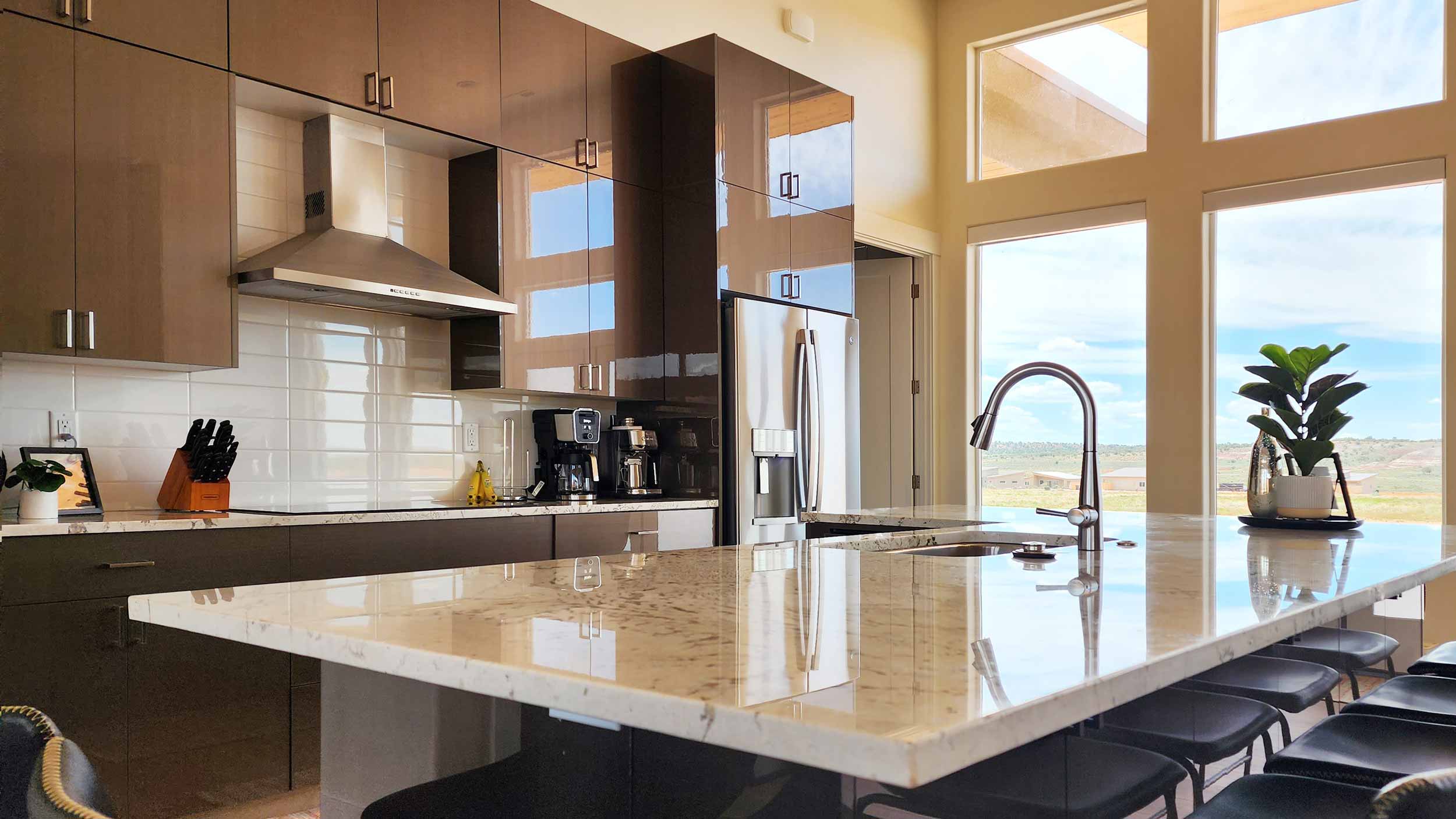

Homeowners planning a kitchen renovation often compare several countertop materials before making a final selection. Understanding the pros and cons of quartzite countertops will help you decide whether the material aligns with your needs and expectations..
Quartzite has grown in popularity because it combines the appearance of elegant natural stone with strong everyday performance in kitchens. Many quartzite slabs feature dramatic veining similar to marble while maintaining the durability associated with harder natural stones.
Some designers love its uniqueness and natural character, while others prefer materials with more predictable patterns or simpler care routines. This guide explains the advantages and limitations of quartzite countertops so homeowners can decide whether quartzite is the right choice for their kitchen.
| Category | Rating | What It Means |
|---|---|---|
| Durability | 5/5 | Excellent long-term performance. |
| Ease of Maintenance | 3/5 | Periodic sealing is necessary. |
| Heat Resistance | 5/5 | Very resistant to heat. |
| Scratch Resistance | 5/5 | The hardest countertop material available. |
| Stain Resistance | 3/5 | Periodic sealing is necessary. |
Choosing Quartzite Countertops: What Matters Most
Why Choose Quartzite Countertops?
Quartzite countertops are often selected when natural stone durability and dramatic geological movement are both priorities. The material is known for combining the visual character of natural stone with strong structural performance.
The Primary Benefit of Quartzite:
Quartzite performs exceptionally well in active kitchens and tolerates high heat and heavy use comfortably. Its density and hardness make it one of the most durable natural stones used for countertops.
Quartzite is extremely hard and highly resistant to scratching. In most kitchen environments it performs as well as or better than granite in terms of scratch resistance.
The Primary Drawback of Quartzite:
Quartzite is extremely dense, which can make it more difficult to fabricate and install compared with many other countertop materials.
What Are Quartzite Countertops?
Quartzite countertops are made from natural stone that is quarried and cut into slabs for countertop fabrication. The stone is valued for its strength and natural movement.
Because quartzite is a natural material, each slab has its own variation in color and pattern. Quartzite countertops are commonly chosen for kitchens where durability and natural stone character are both important.
Advantages of Quartzite Countertops
Quartzite countertops offer several strengths that make them appealing in kitchens where natural stone aesthetics and everyday practicality are both priorities.
Dramatic Natural Stone Appearance
One of the biggest reasons homeowners choose quartzite is its striking natural veining.
Many quartzite slabs feature:
- flowing mineral veins
- bright white or light gray backgrounds
- bold natural movement
These visual characteristics allow quartzite to deliver a marble-like appearance while still maintaining the authenticity of natural stone.
For kitchens where the countertop is meant to be a design focal point, quartzite can create a visually dramatic surface.
Unique Slab Selection
Because quartzite forms naturally underground, every slab contains its own mineral patterns and color variation.
This means each installation is visually unique.
Many homeowners enjoy selecting a specific slab and designing the rest of the kitchen around it. The finished countertop often becomes one of the most distinctive elements in the room.
Comfortable Heat Tolerance for Everyday Cooking
Cooking habits often influence countertop material choices.
Homeowners who frequently move hot cookware directly from the stove or oven to the countertop sometimes prefer natural stone surfaces that tolerate heat comfortably.
Quartzite countertops typically perform well in these everyday situations. While many households still use trivets as a precaution, natural stone surfaces often feel forgiving when dealing with hot cookware.
For a deeper explanation of everyday performance, see the Quartzite Countertop Durability Guide.
Natural Stone Authenticity
Quartzite appeals strongly to homeowners who prefer natural materials in their home.
Because the stone is quarried directly from the earth and fabricated into slabs, quartzite provides the authenticity of a geological material rather than an engineered surface.
For buyers who want the countertop to feel organic and one-of-a-kind, this natural origin can be a significant advantage.
Wide Range of Natural Color Variation
Quartzite occurs in a variety of colors depending on the minerals present in the stone.
Some slabs feature subtle neutral tones, while others display dramatic movement and bold color contrast.
This range allows quartzite to work well in many design styles, from modern kitchens with bright surfaces to traditional interiors emphasizing natural materials.
Potential Drawbacks
While quartzite offers several strengths, homeowners should also understand the limitations that come with natural stone countertops.
Periodic Sealing Requirements
Quartzite is a natural stone and contains microscopic pores that can absorb liquids.
For this reason, quartzite countertops are typically sealed periodically to help maintain stain resistance.
Many homeowners find sealing simple to manage, but it is still an additional maintenance step compared with materials that do not require sealing.
Homeowners interested in detailed care instructions can review the Quartzite Countertop Maintenance Guide.
Slab Variation Can Make Design Planning Harder
Because quartzite slabs are unique, their appearance can vary significantly.
This means:
- the slab seen in a showroom may not match another slab from the same quarry
- multiple slabs used in a kitchen may look slightly different
- designers must plan layout carefully
Many homeowners visit the stone yard to choose their exact slab before fabrication begins.
Matching Stone Later Can Be Difficult
Since quartzite slabs are unique, matching an existing countertop years later can be challenging.
If a kitchen renovation expands in the future or a section of countertop must be replaced, the original stone may no longer be available.
While this situation is uncommon, it is worth considering for long-term renovation plans.
Natural Stone Maintenance Expectations
Quartzite countertops generally require simple care habits.
Homeowners typically maintain the surface by:
- wiping spills promptly
- avoiding harsh cleaning chemicals
- resealing periodically
These routines are manageable for most households but still represent a small additional responsibility compared with some engineered materials.
Pattern Movement May Be *too* Dramatic
Quartzite slabs often feature bold mineral movement and strong visual patterns.
While many homeowners love this dramatic appearance, others prefer surfaces with more subtle or predictable patterns.
Large kitchens with multiple slabs may require very careful layout planning to maintain visual balance across the countertops.
Ideal Use Cases
Quartzite countertops tend to work particularly well in kitchens where natural stone character and visual drama are priorities.
Quartzite is often a strong fit for:
- homeowners who want marble-like veining in natural stone
- kitchens emphasizing dramatic slab patterns
- households that cook frequently
- designs centered around natural materials
Quartzite is also used in bathrooms and other interior spaces where natural stone surfaces complement the overall design.
For a detailed look at where this material performs best in a home, see our Suitability Guide to Quartzite Countertops: The Best (and Worst) Places to Install Quartzite.
Situations Where Another Material May Be Better
Although quartzite works beautifully in many kitchens, other materials may be preferable depending on a homeowner’s priorities.
Quartz or granite may be preferable when homeowners want:
- extremely predictable patterns across large installations (see: quartz, or granite)
- countertops that require minimal ongoing maintenance (see: quartz)
- surfaces with uniform appearance (see: quartz, or granite)
In practice, countertop choices often reflect lifestyle priorities.
Homeowners who choose quartzite usually prioritize:
- natural stone authenticity
- dramatic slab character
- distinctive mineral patterns
Countertop Durability Comparison
For a full side-by-side breakdown of countertop materials, visit our Countertop Durability Comparison, where quartz, granite, quartzite, marble, and dolomite are evaluated using the same durability criteria.